
Open source · Apache-2.0 · Self-hosted

Turn processes into progress.

Write the policy, get it approved by someone other than the author, and prove that everyone read the exact version. Every step lands in an audit trail that can't be quietly rewritten, on servers you control.

Pre-release. The first usable release, R1, targets Jan 2027; 31 of its 32 epics are done. See progress

Animated example of the core loop in Procera: a policy called Remote work is drafted, a reviewer approves it after the author is blocked from approving their own work, it is published with a content fingerprint, twelve people acknowledge it, and each step is added to a hash-chained audit log that verifies.
62epics done, of 135 on the public tracker
288automated end-to-end scenarios against a real server and database
31/32epics done for R1, the first usable release (Jan 2027)
0telemetry by default. Your data stays on your servers
01 · How it works

One loop, from the written rule to the proof that people follow it

Documents in a wiki, sign-offs in email, evidence in a spreadsheet: that's how most teams govern today. Procera keeps the whole loop in one place, with one history.

  1. 01Draft

    Write in the block editor, from a starter template or a blank page.

  2. 02Review

    A second person approves. The author can't approve their own work.

  3. 03Publish

    Go live now or on the effective date. The old version is superseded.

  4. 04Acknowledge

    People confirm the exact version, on a laptop or a phone.

  5. 05Evidence

    Export who acknowledged what, with the content hash and sign-in method.

  6. 06Audit

    Every step is appended to a hash chain that the product verifies.

02 · Design · Execute · Govern · Improve

Four jobs, one product

Each pillar lists what you can use on the main branch today. Everything else is on the roadmap with a date.

v1PolicyIn review
01 · Design

Model and document processes

Write policies and SOPs in a block editor, review them with separation of duties, and publish on a schedule.

  • Policy and SOP library
  • Block editor and exports
  • Reviews with separation of duties
Design features
Confirm by FriAKBBCC2/3
02 · Execute

Automate work across people and systems

Ask people to read and acknowledge, send announcements with receipts, and (from R2) run requests and approvals.

  • Acknowledgement campaigns with evidence
  • Announcements with reach and receipts
  • Notifications and email
Execute features
#10417c1e…#1042a90f…#10433b2d…Chain verified
03 · Govern

Ensure compliance, control and visibility

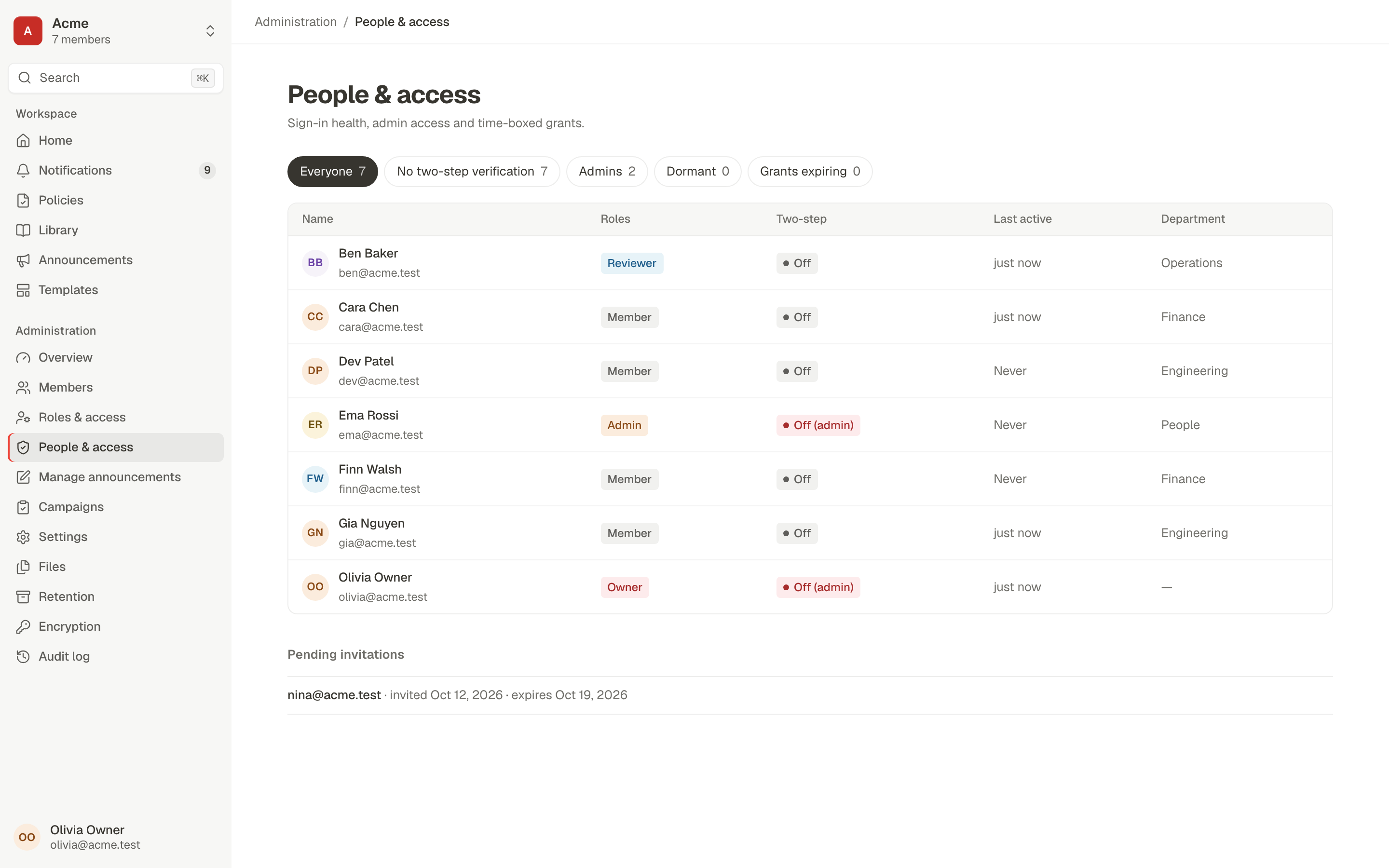
Roles with scoped grants, a hash-chained audit log, encrypted files and workspace isolation enforced in the database.

  • Directory with CSV import and locations
  • Roles and scoped grants
  • Audit log with hash chain, explorer and exports
Govern features
Overduefalling
04 · Improve

Gain insights and continuously optimize

An overview of what needs attention, every list as a data grid with saved views and exports, and reports later on.

  • Data tables with saved views and exports
  • Workspace overview
Improve features
03 · The product, not a mock-up

What you can do today

Every screen here is the real app on the main branch, and every status comes from the public tracker. Workflow automation (requests, forms, the designer) is still being built, and the features page says exactly where it stands.

01
Available now

Policy and SOP library

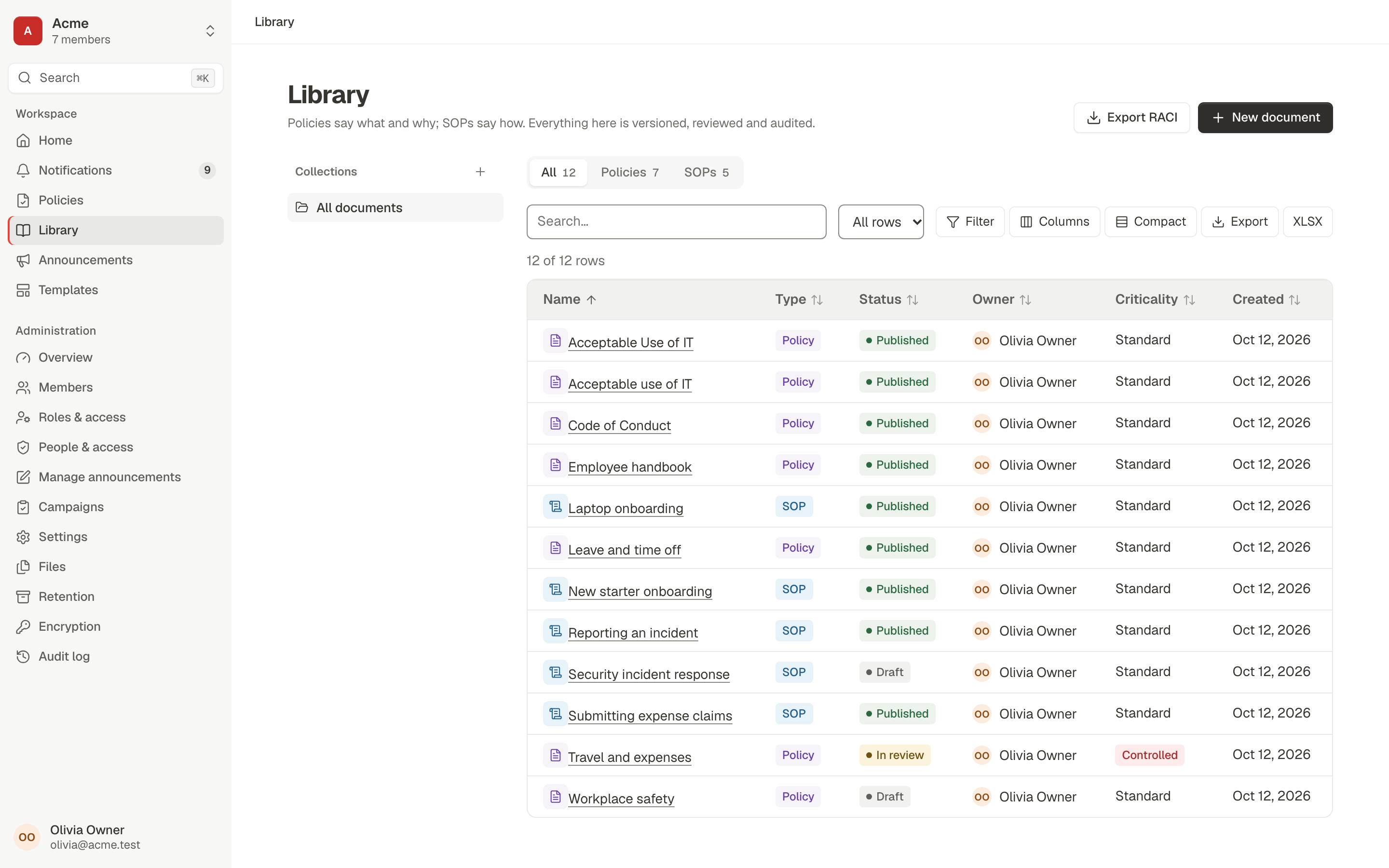
One governed home for policies (what and why) and SOPs (how), each with an owner, a version history and a lifecycle.

  • Lifecycle: draft, in review, approved, scheduled or published, deprecated, retired
  • Collections with per-collection visibility; restricted policies and applicability rules
  • A Policies portal for employees, with what changed between versions
How it works: Policy and SOP library
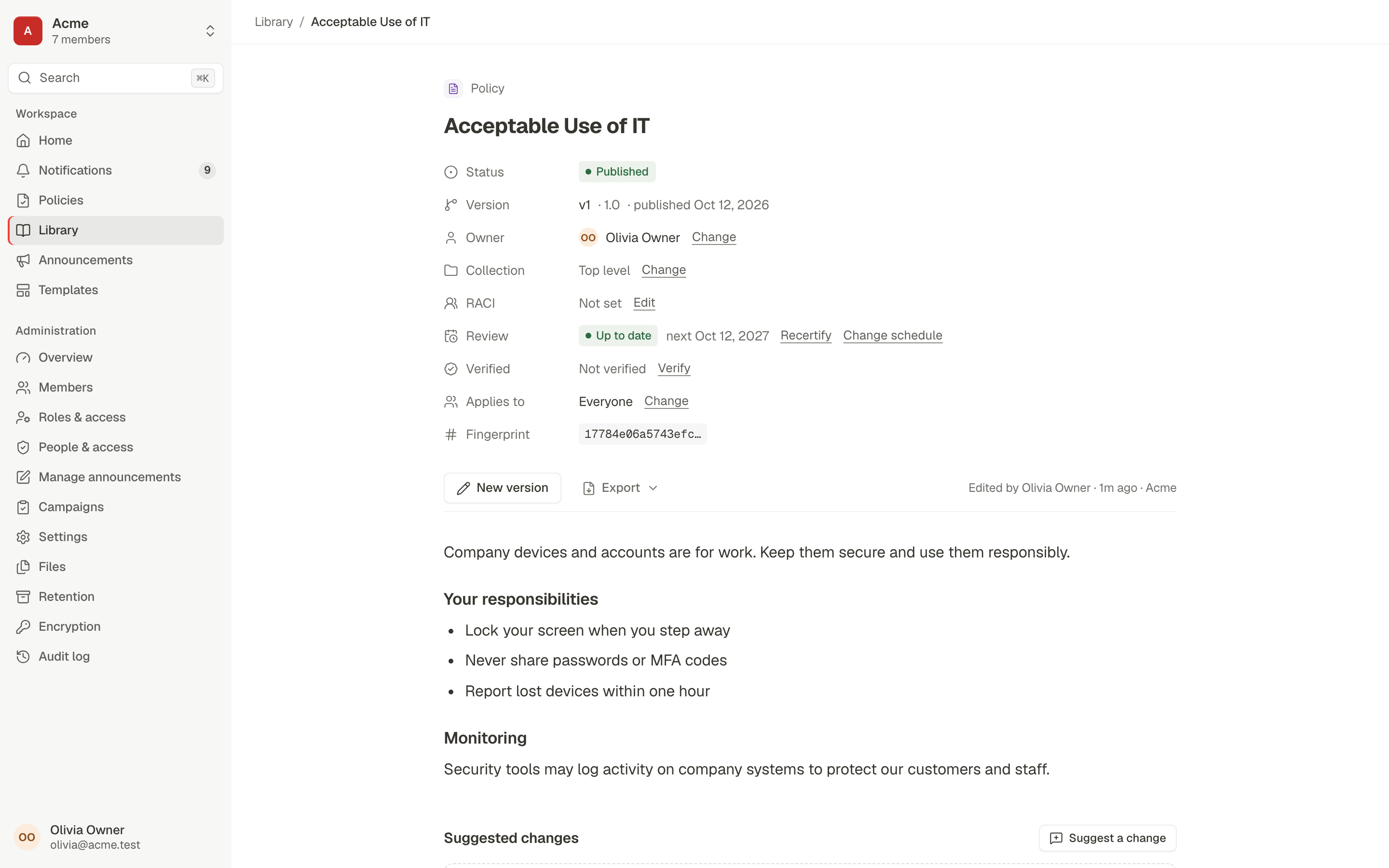
A published policy, Acceptable Use of IT, with its status, version, owner, review date, applicability and content fingerprint above the policy text
02
Available now

Acknowledgement campaigns with evidence

Ask people to read and acknowledge a specific version, chase them politely, and export evidence that stands up later.

  • Audience as a snapshot or kept up to date; people who join later can be included automatically
  • Reminders and manager escalation after the due date
  • Each acknowledgement is bound to the version and its content hash
How it works: Acknowledgement campaigns with evidence
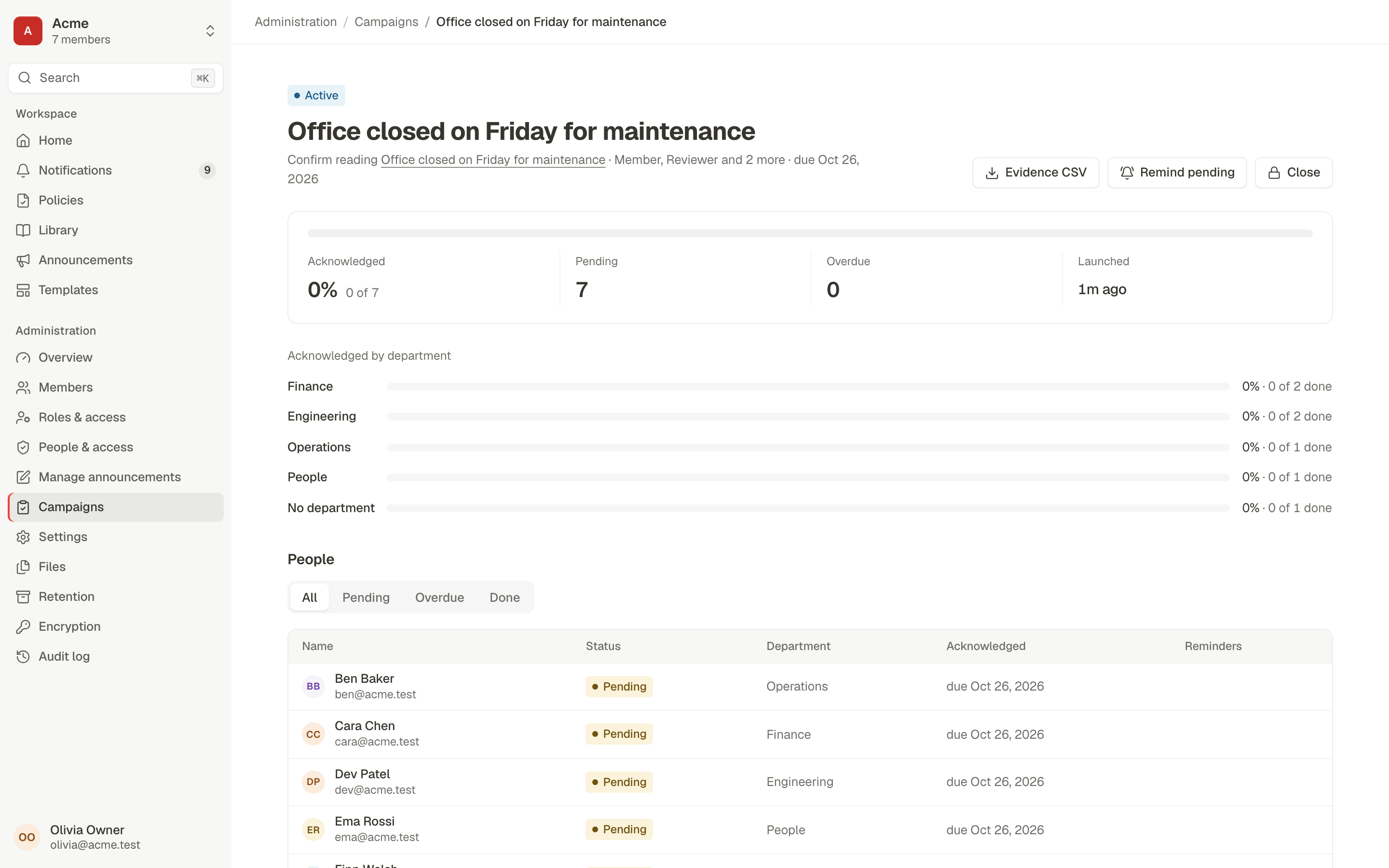
An acknowledgement campaign showing acknowledged, pending and overdue counts, progress by department, and per-person status with an Evidence CSV button
03
Available now

Announcements with reach and receipts

Targeted news and notices, with an optional confirm-by date and approval before anything goes out.

  • Audience by department, group or location from the directory
  • Schedule and expiry, pinned and critical posts
  • Required confirmation with a confirm-by date, reminders and manager escalation
How it works: Announcements with reach and receipts
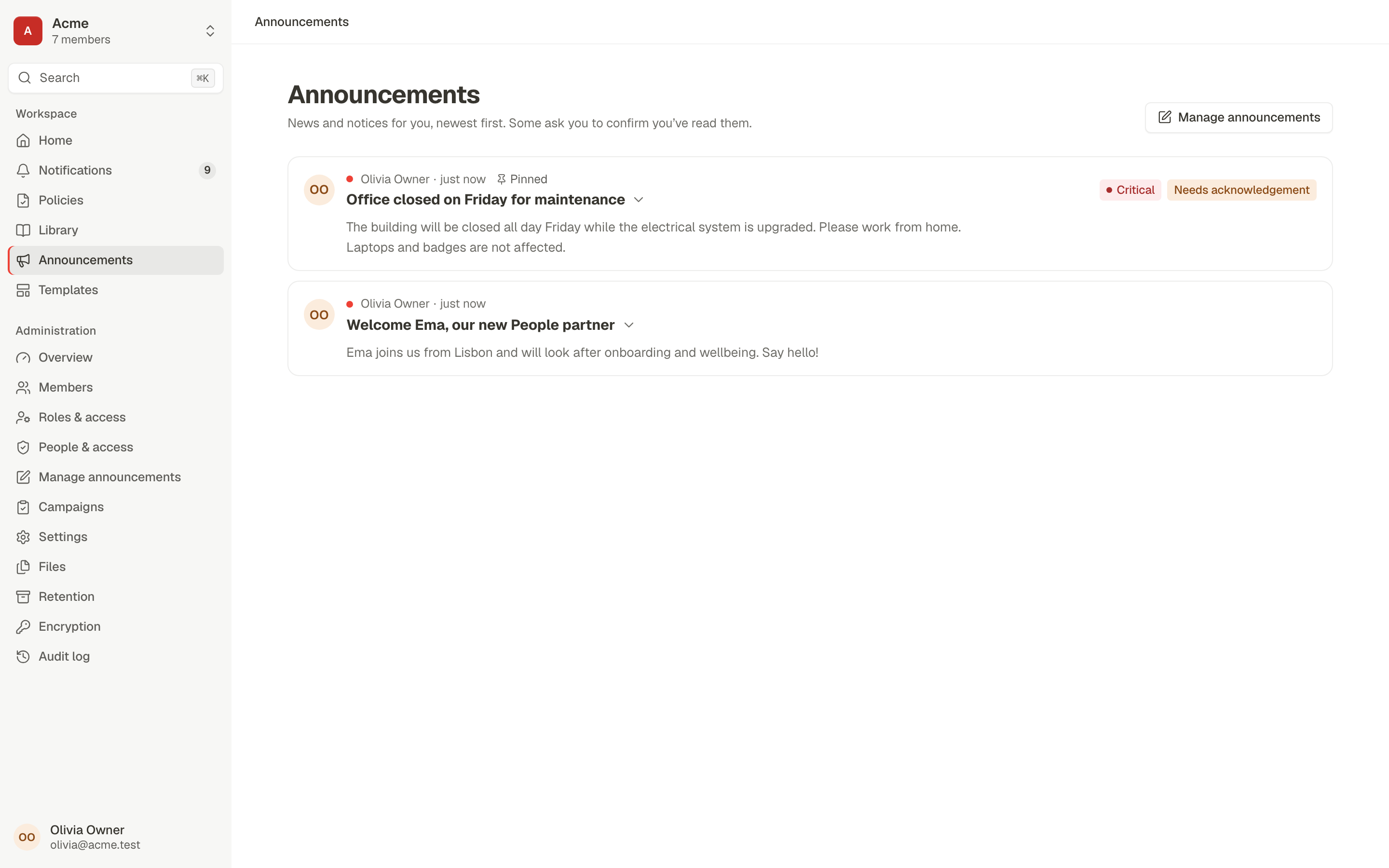
The announcements feed with a pinned critical post that needs acknowledgement and a welcome post
04
Available now

Audit log with hash chain, explorer and exports

Every change and every sensitive read is recorded in a per-workspace hash chain. Records can't be edited or deleted.

  • Tamper-evident chain with verification in the product
  • Explorer with filters, person and document timelines, and saved queries
  • CSV and JSONL exports that need step-up and are themselves audited
How it works: Audit log with hash chain, explorer and exports
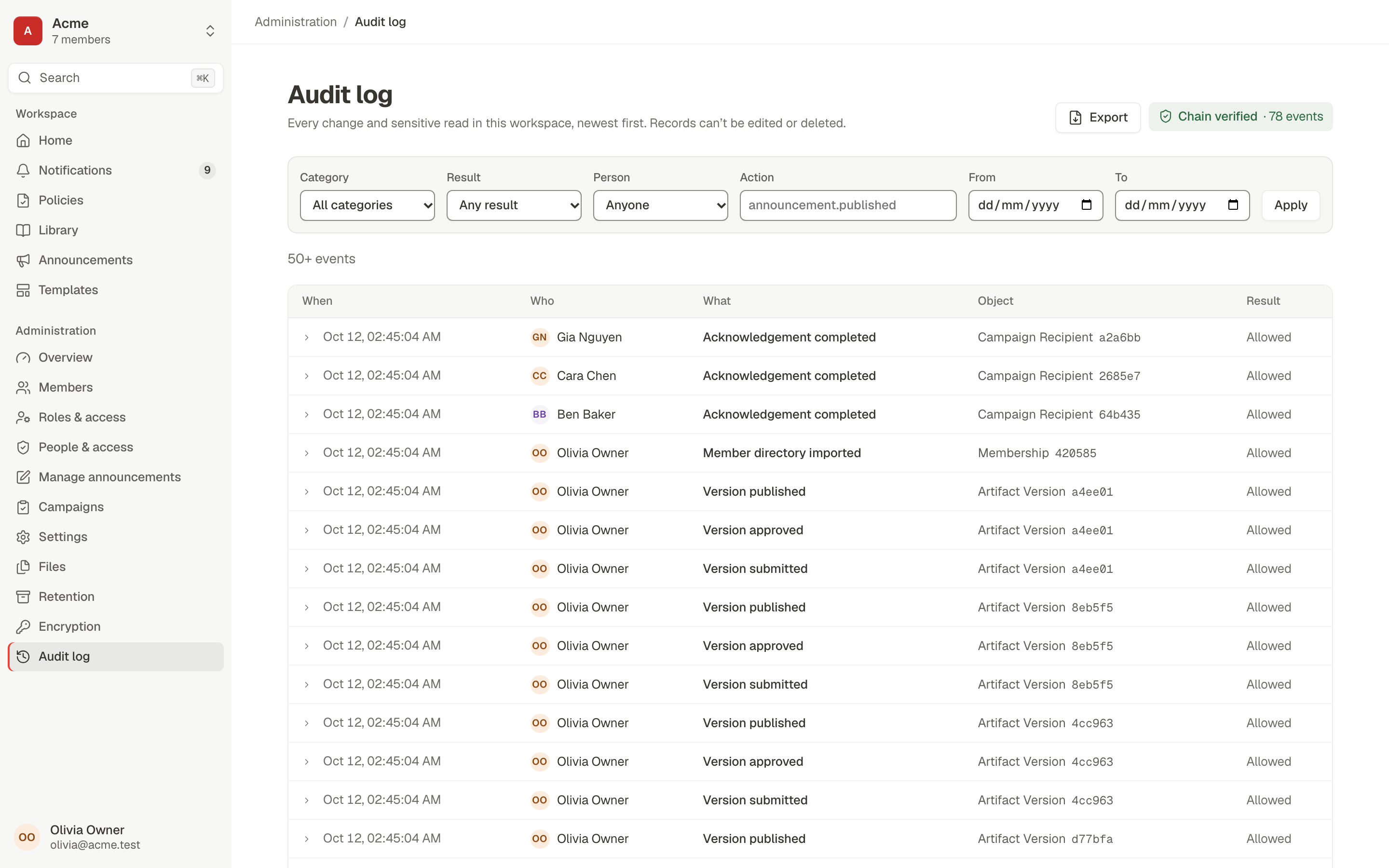
The audit log with filters for category, result, person and dates, a Chain verified badge with 78 events, and a list of who did what to which object
05
Available now

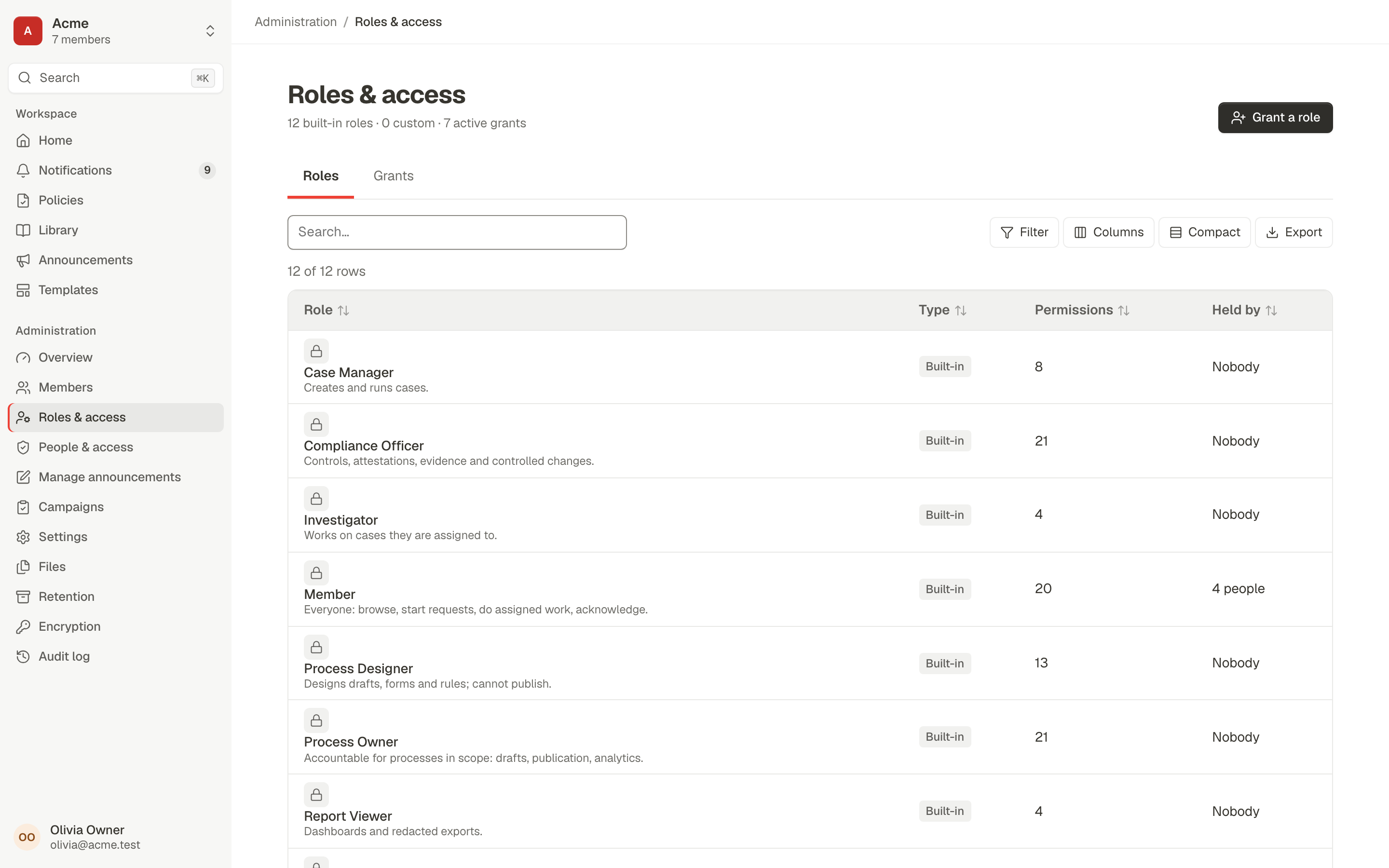
Roles and scoped grants

A permission catalogue, built-in role templates and custom roles, granted to people or groups and scoped to a department or collection.

  • 12 built-in role templates; custom roles cloned from them
  • Grants scoped to the workspace, a department or a collection
  • A preview of who gains or loses what before you save
How it works: Roles and scoped grants
Roles and access: built-in roles such as Compliance Officer, Member and Process Owner with their permission counts and holders
procera.example.com/library/acceptable-use-of-it
A published policy, Acceptable Use of IT, with its status, version, owner, review date, applicability and content fingerprint above the policy text
An acknowledgement campaign showing acknowledged, pending and overdue counts, progress by department, and per-person status with an Evidence CSV button
The announcements feed with a pinned critical post that needs acknowledgement and a welcome post
The audit log with filters for category, result, person and dates, a Chain verified badge with 78 events, and a list of who did what to which object
Roles and access: built-in roles such as Compliance Officer, Member and Process Owner with their permission counts and holders
04 · Who it's for

See it from your desk

From a ten-person startup to a multinational, in every department. Pick a role.

People and HR

Publish the handbook once. Know who has read it.

Start from the employee handbook pack, get it reviewed, and send it to everyone with a due date. Reminders and manager escalation do the chasing.

  • Start from the Employee handbook pack: five drafts to adapt
  • Acknowledgement campaigns tied to the exact version
  • Reminders, then the manager hears about anyone overdue
  • Departments, managers and locations from a CSV import

Next: Leave and onboarding requestsAvailable now

Handbook v3AKBBCCDPER3 of 5 acknowledged
An acknowledgement campaign showing acknowledged, pending and overdue counts, progress by department, and per-person status with an Evidence CSV button
05 · Where Procera leads

The parts other tools leave to spreadsheets

  1. 01

    Acknowledgements bound to the version

    Each acknowledgement records the version and its content hash, so “I read it” means this text, not whatever the page says today.

    Available now
  2. 02

    Separation of duties that can't be skipped

    Authors can't approve their own documents, and reviewers confirm it's them with step-up before an approval counts.

    Available now
  3. 03

    Announcements with receipts

    Target a department, group or location, set a confirm-by date, and see reach and read receipts per post.

    Available now
  4. 04

    An audit trail that shows tampering

    Every mutation and restricted read is chained by SHA-256. Change one record and verification fails from that point on.

    Available now

How verification works (an illustration, with shortened hashes)

  1. #10417c1e09ab
    document.publishedOlivia Ownerprev 52f0c3d1
  2. #1042a90f44e2
    acknowledgement.recordedBen Bakerprev 7c1e09ab
  3. #10433b2d71c8
    acknowledgement.recordedCara Chenprev a90f44e2
  4. #1044e07a5f16
    evidence.exportedOlivia Ownerprev 3b2d71c8

Chain verified: 4 records

06 · Built in the open

What's next, on a public schedule

Each release is usable on its own and ships when its end-to-end test gate passes. Requests and approvals arrive with R2; e-signing with R3.

  1. R1Jan 2027Workspace and PoliciesPlanned · 31/32
  2. R2Mar 2027Requests and ApprovalsPlanned · 18/22
  3. R3May 2027Operate and SignActive · 2/18
  4. R4Jul 2027Enterprise ConnectActive · 0/14
  5. R5Aug 2027Cases and CompliancePlanned · 0/11
  6. GAOct 20271.0 hardening + releasePlanned · 0/8
07 · Open source and self-hosted

Your policies and your evidence stay on your servers

Apache-2.0, with no telemetry by default. Procera needs PostgreSQL and an SMTP server. Valkey is an optional cache, and files sit on local disk today, with an S3-compatible backend next.

  • PostgreSQL 16+
  • SMTP
  • Valkey (optional)
  • ClamAV (recommended)
terminal
$ git clone https://github.com/CasualOffice/Procera.git
$ cd Procera
$ less docs/00-INDEX.md
# design docs, tracker and E2E packs are all in the repo
Apache-2.0
Use it, change it, run it commercially.
Forced row-level security
On every workspace table, checked by a cross-workspace test sweep.
288 scenarios
Automated end-to-end tests gate each release.

Start with one policy. Prove it was read by Friday.

Run it on your own server with Docker Compose, read the code and the design, and follow R1 as it lands. No sign-up, no sales call.